A Tutorial on Sensitivity and Specificity in Medical Diagnostic Tests
A Discussion with Biodesix Co-Chief Medical Officer, Dr. Steve Springmeyer
Dr. Steve Springmeyer, Co-Chief Medical Officer, Biodesix: Steven Springmeyer, MD, is a board-certified physician in Pulmonary and Critical Care Medicine with over 29 years of experience in direct patient care. He founded the University of Washington Pulmonary Section at the Fred Hutchinson Cancer Research Center and was a Clinical Professor of Medicine until 2019. Dr. Springmeyer was also a key contributor to the clinical research and development of the Spiration Valve System. He has been with Biodesix since 2018.
Please find a more detailed bio here.
Oftentimes, the “sensitivity and specificity” of diagnostic tests is mentioned to measure the value or benefit of a test. Can you explain what sensitivity and specificity are?
Dr. Springmeyer: I’ll start with an analogy to explain the parameters of “sensitivity and specificity”. For successful and productive human interactions, it’s ideal to be sensitive to others and to be specific when choosing one’s friends.
The analogy applies to developing medical diagnostic tests.
For example, a blood glucose measurement is sensitive to glucose elevations, but there are many variables that can cause glucose elevations, so it is not specific enough to provide a formal diagnosis of diabetes.
What lung cancer diagnostic test is best optimized for both sensitivity and specificity?
Dr. Springmeyer: In lung cancer, the only test that is truly optimized for both sensitivity and specificity is a tissue biopsy that is reviewed by a specialized medical pathologist. However, performing a lung biopsy procedure can pose significant patient risks, so surgical or needle biopsies are commonly reserved for when the patient’s nodule poses a very high likelihood of cancer.
How does a doctor or medical professional decide whether or not to proceed with a lung nodule biopsy or surgical procedure?
Dr. Springmeyer: For the Medical Professional, deciding the probability, or risk, of lung cancer for the patient is a critical decision, yet it is often not a clear-cut decision.
The Medical Professional must weigh multiple variables and options for the patient, on a case-by-case basis.
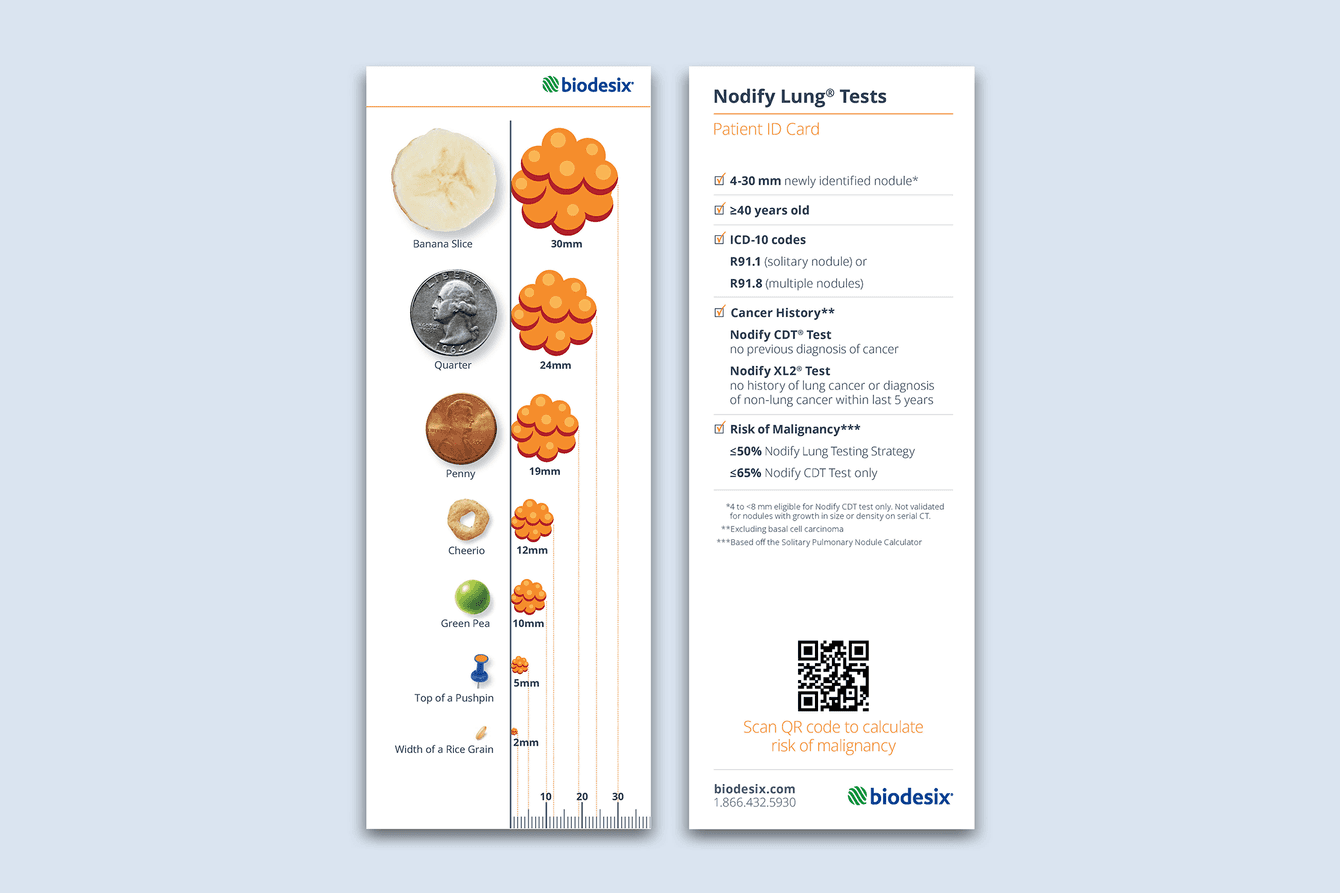
For example: when a Cheerio-size “spot on the lung” pulmonary nodule is found, we have to consider what is the optimal care pathway for that specific patient. We know that prompt surgery for a small lung nodule has the potential to cure lung cancer. On average, there is a 90% cure with surgery for a Cheerio-size cancerous nodule. However, we must also balance that there are risks to performing the biopsy and resection, depending on the patient’s overall health.
What is the relationship between “sensitivity and specificity” of diagnostic tests and the published Lung Cancer Risk Calculators? What are the sensitivity and specificity scores of the various Lung Cancer Risk Calculators?
Dr. Springmeyer: There are several published Lung Cancer Risk Calculators for lung nodules, but current studies show no single Lung Cancer Calculator that is as good as a well-trained Lung Specialist:
- The expert Lung Specialists have a Sensitivity and Specificity score of 0.85 (85%), so they are wrong ~15% of the time.
- The best Risk Calculator is wrong ~22% of the time.
- When a new nodule is observed by x-ray or CT imaging, the guidance in the Radiology Report will generally be based on the nodule size alone and that Radiology Report is wrong ~35% of the time.
Why do the published Lung Cancer Risk Calculators have such poor sensitivity and specificity scores?
Dr. Springmeyer: The estimates produced by the published Risk Calculators are based on the combined and blended sensitivity and specificity measurements. I believe that sensitivity and specificity need to be considered separately from each other.
For example, if the nodule has diffuse calcium, that finding provides a very high sensitivity. Yet, it does not indicate or confirm the reason for the high calcium, so that finding has very low specificity. So, while the sensitivity is high, it is also highly probable to conclude that the nodule is not cancer.
When is a lung nodule classified as “indeterminate”? What is an indeterminate lung nodule?
Dr. Springmeyer: Lung nodules that don’t have specific findings from Radiology and have no prior images (historical images) of the patient’s lungs for comparison of the lung nodule size changes over time are designated as “indeterminate”.
These indeterminate nodules require further medical evaluation to be able to determine lung cancer probability. This is where advanced diagnostic tests, like the Nodify Lung® test from Biodesix, can be very useful for clinical decision-making and more efficient patient triage.
Biodesix blood tests are introduced AFTER a scan, or an x-ray, or a CT image, identifies that a lung nodule is present. Why is that?
Dr. Springmeyer: Biodesix tests are specifically focused on the early diagnosis of lung cancer and accelerated patient triage to get each patient into the correct care pathway. The fundamental clinical approach for Biodesix is this:
- On a scan, if a new, indeterminate nodule measures 4-30 mm, then there is an opportunity for the healthcare professional to order Nodify Lung testing to help better determine the patient’s risk of cancer.
There is a published paper that states that 95% of lung nodules are not cancer; what affects that percentage?
Dr. Springmeyer: Yes, there is a widely quoted research paper that states that 95% of lung nodules are not cancer. However, the patient population, or patient cohort, studied for that specific paper includes a high volume of patients with very small nodules, that measure less than 8 mm. In general practice, patients with nodules this small are simply followed (via imaging surveillance) for size changes, or growth, over time, before any further medical testing or biopsy is pursued to confirm if the nodule is benign or cancerous.
Are there any shortcomings or weaknesses using Sensitivity and Specificity parameters for lung nodule diagnostics or lung cancer screeners?
Dr. Springmeyer: There is a pitfall, or weakness, in using Sensitivity and Specificity and that is related to the prevalence of the disease in a specific study group (of patients).
In lung cancer, there are calculators available with a low cancer prevalence group like lung cancer screen-detected nodules. The implication is that for a particular group of patients studied, that only has a cancer prevalence of 5%, then 95% of the time you will be tempted to conclude “there’s no cancer” for those patients. Most Lung Cancer Calculators, should adjust for prevalence but, in general, the adjustments are only material in either the high or the low prevalence situations.
A Lung Cancer Risk Calculator provides a risk value from a particular population studied, such as a group of Veterans, or, say, a patient group at the Mayo Clinic. A single patient is rare to align perfectly with the particular group studied. Instead, a best-fit calculator and a doctor’s experience are ultimately used to estimate cancer risk.
- If the risk is very low, <5% risk, observation, or CT surveillance, is common.
- With very high risk, >65%, a biopsy is often recommended.
However, most patients, (approximately 80% of patients), fall in between these two extremes of “high” and “low” risk. That is a lot of patients!
How does the Biodesix testing approach differ from the lung cancer calculators or physician estimates?
Dr. Springmeyer: For all those patients that are neither very high nor very low risk that’s where the Biodesix testing brings the most value. Biodesix Nodify Lung testing offers another important layer of information. With Nodify Lung testing, healthcare professionals can complete a more accurate and timelier patient triage (less subjectivity) and make more informed decisions (less variability) on their patients’ options for the next steps, helping deliver more personalized care.
Are the Nodify Lung tests from Biodesix, or blood biomarkers, new to the field of lung nodule management?
Dr. Springmeyer: The combined Nodify Lung tests from Biodesix became available in 2020 and Biodesix worked with healthcare professionals to continue to provide clinical validation data and clinical research results since then. Before Nodify Lung testing, the only clinical options for these “in between” patients (that are neither high nor low risk for lung cancer) included “watchful waiting”, bronchoscopic biopsy, PET, or PET/CT scans, or biopsies with needles or surgery for nodule resection.
Those are a lot of options for those “in between” cancer probability patients. Why is there a need for a blood test like the Nodify Lung tests?
Dr. Springmeyer: As stated earlier: sensitivity and specificity can be considered separately from each other. The Biodesix Nodify CDT® test has a very good specificity at (91–97%). That means a false-positive rate is 3-9%. This compares favorably to PET/CT scans where a head-to-head comparison with PET/CT showed a Nodify CDT test false-positive rate of 7% compared to PET/CT false-positive rate of 42%.
With the Nodify XL2® test, the false-negative rate is low at 2% whereas recent PET/CT studies have shown false-negative rates of 13 and 25%. The effect of false-negative rates is a delayed diagnosis (delays can allow the cancer to grow).
PET/CT remains important for staging cancer nodules, but as I described above, the Nodify Lung blood tests may reduce unnecessary procedures on benign nodules and should be considered for patients before performing a PET/CT scan.
What happens when the spot on the lung measures larger than 30 mm?
Dr. Springmeyer: A newly identified “spot” on the lung that measures larger than 30 mm is termed as a “mass” rather than a nodule. A mass is most likely a cancer and will be managed differently than nodules sized 30 mm or less.
*note: Biodesix Nodify CDT testing includes patients presenting with 4–8 mm nodules.