Life Sciences Development Services

The GeneStrat® ESR1 ddPCR™ Test
Biodesix develops, validates, and runs blood-based tests in its CAP accredited, CLIA/NYS CLEP and ISO 13485 certified laboratory. The GeneStrat® ESR1 ddPCR™ Test for patients with breast cancer is the newest addition to the portfolio: 11 ESR1 resistance variants detected in plasma at variant allele frequencies as low as 0.06%. It is an ultrasensitive blood test for ESR1 resistance variants in metastatic HR+/HER2- breast cancer and is available as a laboratory developed test (LDT).
Highlights And Distinguishing Features
- 11ESR1 variants detected, plus wildtype targets
- 0.06%Lowest limit of detection by variant allele frequency
- 100%Analytic specificity across all targets
- 25 of 25Clinical specimens concordant with reference NGS in the first cohort
- NYS CLEPTest Approved March 2026
How the ESR1 Test Was Developed
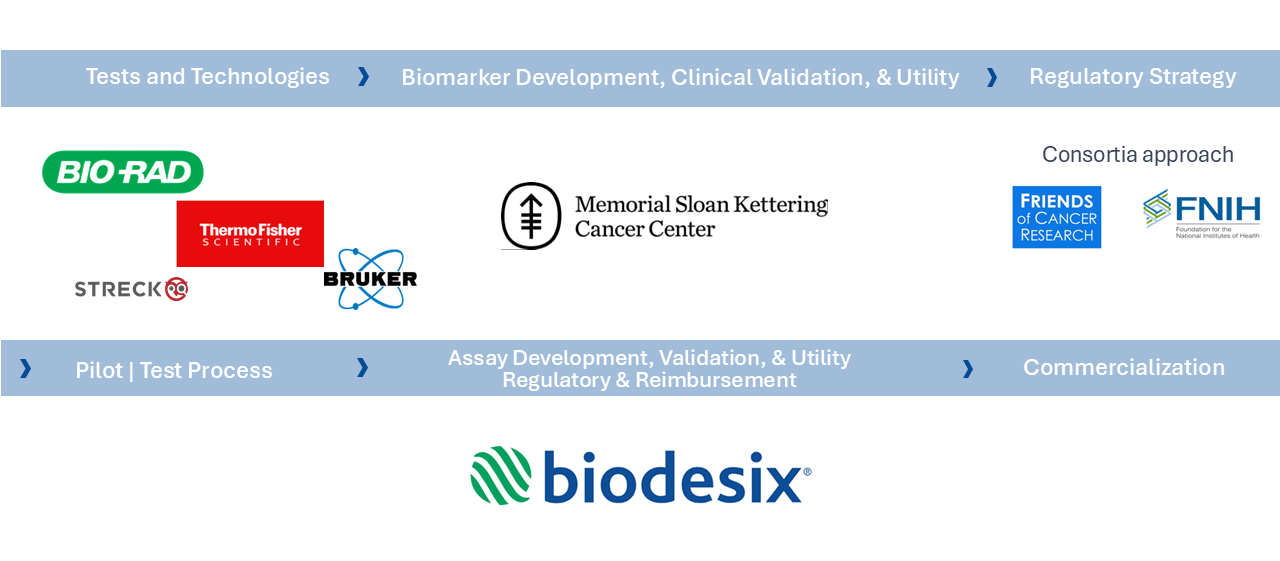
The test was developed under an expanded partnership agreement with Bio-Rad Laboratories announced in October 2025. Under the agreement, Biodesix conducts development, clinical validation, and regulatory submissions for in vitro diagnostic assays built on Bio-Rad’s Droplet Digital™ PCR technology and QX600™ platform for advanced multiplexing. The two companies have worked together on ddPCR test for many years.
Clinical validation was completed in collaboration with Memorial Sloan Kettering Cancer Center; clinical performance of the test is described below. The test was granted NYS CLEP approval on March 12, 2026. The test is available to patients in all 50 U.S. states. Testing for ESR1 is included in NCCN Guidelines.
Why ESR1 Mutations Matter Clinically
ESR1 mutations may be a major mechanism of acquired resistance to aromatase inhibitor plus CDK4/6 inhibitor therapy. They are rare at baseline, present in under 5% of patients, but emerge in roughly 40% of patients at progression. Tumors carrying these mutations resist aromatase inhibitors while remaining sensitive to selective estrogen receptor degraders such as camizestrant.
Since the mutations emerge under treatment pressure rather than being present from the start, patients may undergo repeat testing with ultrasensitive assays in a non-invasive and cost-effective manner. ctDNA-based ESR1 testing may be performed as often as every two to three months during first-line therapy, and the ctDNA approach may detect emerging mutations roughly six months before clinical progression becomes apparent. Repeated testing may allow earlier intervention, delayed progression, and better patient-reported outcomes.
The 11 ESR1 Variants and Four Wildtype Targets
The test provides coverage of the eleven most common variants in the ESR1 gene, which follows the most prevalent ESR1 activating mutations described by Grinshpun et al. (2023), and the MSKCC Cancer Hotspots database, which identified single-residue and in-frame indel hotspots across 24,529 tumor samples.
| Exon | Variant | Coding change | COSMIC ID |
|---|---|---|---|
| 5 | E380Q | c.1138G>C | COSV52782264 |
| 7 | S463P | c.1387T>C | COSV52784970 |
| 8 | L536R | c.1607T>G | COSV52787207 |
| 8 | Y537C | c.1610A>G | COSV52782924 |
| 8 | Y537N | c.1609T>A | COSV52784978 |
| 8 | Y537S | c.1610A>C | COSV52783938 |
| 8 | D538G | c.1613A>G | COSV52781024 |
| 6 | V422del | c.1265_1267del | COSV52789441 |
| 8 | L536H | c.1607T>A | COSV52795259 |
| 8 | L536P | c.1607T>C | COSV52782930 |
| 8 | Y537D | c.1609T>G | COSV52804811 |
Clinical Laboratory Workflow
Specimens have been validated for testing following up to four days in transit in Streck cfDNA tubes at ambient temperature. The clinical validation study collected 10 to 20 mL of whole blood in Streck cfDNA BCT tubes, with plasma isolated and stored at minus 80 degrees Celsius prior to extraction of cfDNA. All samples were blinded to operators performing testing.
- 1Specimen shipmentWhole blood in cfDNA blood collection tubes (IVD)
- 2AccessioningBiodesix data management system
- 3ExtractioncfDNA extracted from plasma and quantified
- 4ddPCRQX600 AutoDG ddPCR System
- 5Data analysisQX Manager Software, Premium Edition
- 6ReportingVariant positive, variant negative (wildtype), or QNS
The Assay Development Process
Tests at Biodesix follow a rigorous process, run against CLSI guidance and the New York State CLEP oncology assay guidelines.
- Feasibility: Design, synthesis, and initial specificity testing against controls: synthetic targets and cell lines.
- Verification: Assay performance optimized against defined test and control targets, including specimens from healthy and cancer donors. Workflow steps are process-verified across pre-analytic, analytic, and post-analytic variables.
- Validation: Limit of detection, precision (intra-day, inter-day, inter-operator), ship and shelf stability, healthy donor specificity, clinical sensitivity and specificity in cancer donor specimens, software validation, and final acceptance testing on field specimens.
Analytic and Clinical Performance
Results of Limit of blank and Limit of detection studies are shown below. Specificity, precision, and clinical accuracy studies followed NYS CLEP oncology assay guidance.
Analytical Validation Results
| Study | Result |
|---|---|
| Limit of blank (LoB95) | 0.0-3.4 mutant copies per test, assay dependent |
| Limit of detection (LoD95) | 0.06%-0.20% variant allele frequency |
| Analytic specificity | 100% across all targets |
For complete analytical validation results, refer to Jackson LP, Barnett E, Halpin H, et al. Development of a clinical-grade ultrasensitive droplet digital PCR test for monitoring of relevant ESR1 variants by liquid biopsy. J Liq Biopsy. 2026;14:100675. doi:10.1016/j.jlb.2026.100675
Test Precision
Repeatability and reproducibility were verified across five runs over three days of testing. Each run included three positive samples at high, medium, and low input (one to two times the limit of detection) plus one negative sample. Intra-day and operator precision used three runs on the same day by two different operators; inter-day precision used three runs on three different days by the same operator. Two instrument workflows were included but not evaluated as independent variables. Acceptance criteria were that negative controls test negative and positive controls test positive. All analytes passed.
Clinical Validation and Accuracy
The clinical validation study was a collaboration with Memorial Sloan Kettering Cancer Center enrolling up to 50 patients with metastatic HR+/HER2- breast cancer. Physician identified prospective patients who were thought to have disease progression and were undergoing genomic profiling with a commercially available ctDNA next-generation sequencing assay, either Guardant360 or MSK-ACCESS. Blood was collected concurrently with clinical profiling, and frozen plasma was shipped to Biodesix for blinded ddPCR testing.
In the first cohort of 25 blinded clinical plasma specimens, results were 100% concordant with the reference NGS assays: 7 of 7 reference-positive specimens were called positive and 18 of 18 reference-negative specimens were called negative. Variant allele frequencies tracked closely between methods, with a fitted slope of 0.944 and R-squared of 0.9979. One additional variant was detected by the GeneStrat ESR1 ddPCR test that the reference method did not report. Acceptance criteria were at least 300 wildtype copies in every test sample, correct calls on both control types, and 95% label-level concordance.
| GeneStrat ESR1 ddPCR test result | Reference NGS positive | Reference NGS negative |
|---|---|---|
| Positive | 7 | 0 |
| Negative | 0 | 18 |
Trademarks
- ddPCR, Droplet Digital, and QX600 are trademarks of Bio-Rad Laboratories, Inc.
- GeneStrat, VeriStrat, Nodify Lung, Nodify CDT, Nodify XL2, and IQLung are trademarks of Biodesix, Inc.
- Guardant360 is a trademark of Guardant Health, Inc.
- MSK-ACCESS is a trademark of Memorial Sloan Kettering Cancer Center.
References
ESR1 test development and validation
- Jackson LP, Barnett E, Halpin H, et al. Development of a clinical-grade ultrasensitive droplet digital PCR test for monitoring of relevant ESR1 variants by liquid biopsy. J Liq Biopsy. 2026;14:100675. doi:10.1016/j.jlb.2026.100675
- Pestano G, Jackson L, Barnett E, Halpin H, Erazo T, Bonelli B, Eller K, Razavi P. Validation of a droplet digital PCR test for monitoring ESR1 ctDNA variants in blood. J Clin Oncol. 2026;44(16_suppl):e13066. doi:10.1200/JCO.2026.44.16_suppl.e1306
- Jackson L, Halpin H, Pestano GA. Development of an ultra-sensitive droplet digital PCR test for monitoring ESR1 variants by liquid biopsy: GeneStrat ESR1 Test. Poster presented at: San Antonio Breast Cancer Symposium; December 9-12, 2025; San Antonio, TX.
- François-Clément Bidard, Erica Mayer, Yeon Hee Park, Wolfgang Janni, Cynthia Ma, et al. First-Line Camizestrant for Emerging ESR1-Mutated Advanced Breast Cancer. New England Journal of Medicine, 2025, 393 (6), pp.569-580. ⟨10.1056/NEJMoa2502929⟩.
- Biodesix, Inc. Biodesix announces expanded Bio-Rad Laboratories partnership agreement to develop Droplet Digital PCR high complexity assays. Press release. October 22, 2025.
- Grinshpun A, et al. ESR1 activating mutations: from structure to clinical application. Biochim Biophys Acta Rev Cancer. 2023;1878(1):188830.
- Cancer Hotspots database, MSKCC. Prevalence of single-residue and in-frame indel mutation hotspots identified in 24,529 tumor samples, per the algorithm described in Chang et al. 2016 and Chang et al. 2017.
- Krebs MG, Malapelle U, Andre F, et al. Practical considerations for the use of circulating tumor DNA in the treatment of patients with cancer: a narrative review. JAMA Oncol. 2022;8(12):1830-1839. doi:10.1001/jamaoncol.2022.4457
Related Biodesix ctDNA and ddPCR work
- Andrews HS, Zariffa N, Goren EM, Nishimura KK, Rosenthal A, Abukhdeir A, Collins G, Dajee M, Deng Y, Deng S, Ensor J, Espenschied CR, Fabrizio D, Guha M, Hodgson D, Juraeva D, Kräemer N, Leparc GG, Levi-D'Ancona E, Liu M, Merino Vega D, Navarro-Serer B, Pestano GA, Solovieff N, Sridhar S, Stewart MD, Sullivan JP, Wojciekowski S, Hoering A, Allen JD. Associations between early changes in circulating tumor DNA (ctDNA) and outcomes across randomized trials: Insights from the ctMoniTR project. J Liq Biopsy. 2026 Jul 15;13:100481. doi: 10.1016/j.jlb.2026.100481. PMID: 42519677; PMCID: PMC13382393.
- Weaver A, Diercks A, Corral A, Sowada M, Cotten S, Stephen A, Halpin H, D'Alessio B, Rill K, Longshore E, Jackson L, Tomazin H, Eller KA, Pestano GA. First experiences in a US clinical laboratory with Oncomine Dx Express Test: Evaluation in formalin-fixed paraffin-embedded tissues. Mol Cell Probes. 2026 Aug;88:102071. doi: 10.1016/j.mcp.2026.102071. Epub 2026 May 22. PMID: 42176872.
- Paweletz CP, Forbes TD, Yee L, Heavey G, He HJ, He Z, Connors D, Stetson D, Keating S, Cole KD, Chen L, Pauly R, Bao H, Wu X, Pestano GA, Weaver AL, Kohli M, Hellwig S, Corner AS, Prantner AM, Wong SQ, Fox SB, Hewitt CA, Arnolda R, Jones GR, Craft J, McConechy M, Qahtani MA, Klemm F, Mohammad F, Sigman C, Liu LC, Gan Q, Konigshofer Y, Garlick R, Chin E, Kelloff G, Williams PM, McCormack R, Karlovich C. Functional Characterization and a Real-World Clinical Laboratory Pilot of the Foundation for the National Institutes of Health Circulating Tumor DNA Quality Control Materials. JCO Precis Oncol. 2025 Nov;9:e2500245. doi: 10.1200/PO-25-00245. Epub 2025 Nov 6. PMID: 41197083; PMCID: PMC12614329.
- McKelvey BA, Andrews HS, Baehner FL, Chen J, Espenschied CR, Fabrizio D, Gorton V, Gould C, Guinney J, Jones G, Lv X, Nahorski MS, Palomares MR, Pestano GA, Sausen M, Silk A, Zhang N, Zhang Z, Stewart MD, Allen JD. Advancing Evidence Generation for Circulating Tumor DNA: Lessons Learned from A Multi-Assay Study of Baseline Circulating Tumor DNA Levels across Cancer Types and Stages. Diagnostics (Basel). 2024 Apr 27;14(9):912. doi: 10.3390/diagnostics14090912. PMID: 38732326; PMCID: PMC11083008.
- Andrews HS, Zariffa N, Nishimura KK, et al. Clin Cancer Res. 2025;31(11):2162-2172.
- Bowling M, Arastu H, Edwards V, et al. Cancer Drug Resist. 2019;2(3):912-916.
- Mellert HS, Alexander KE, Jackson LP, Pestano GA. J Vis Exp. 2018;(134):57079.
- Mellert H, Foreman T, Jackson L, et al. J Mol Diagn. 2017;19(3):404-416.
- Hartmaier RJ, Markovets AA, Ahn MJ, et al. Cancer Discov. 2023;13(1):98-113.
- Vaclova T, Grazini U, Ward L, et al. Nat Commun. 2021;12:1780.
- Papadimitrakopoulou VA, Han JY, Ahn MJ, et al. Cancer. 2020;126(2):373-380.
- Pritchett MA, Camidge DR, Patel M, et al. JCO Precis Oncol. 2019;3:PO.18.00299.